There’s a moment, somewhere on the road between Mostar and Kotor, when the Balkans stops being a destination and starts being a feeling. The road narrows, the tarmac fades to something older and rougher at the edges, and the mountains close in around you like they’ve been waiting. You twist the throttle and the engine note bounces off limestone walls, and you think: nobody told me it was going to be like this.
The Balkans has long been the road less travelled for motorcycle tourers. Western Europe gets the postcard treatment — the Alps, Tuscany, the Pyrenees — while this wild, beautiful, bruised corner of the continent sits quietly waiting for those willing to look east. It is a region that has absorbed empires, survived wars, and is now emerging with a self-confidence that feels fresh and genuine. Riders who make the journey come back with something different in their eyes. A kind of quiet satisfaction that comes from roads that have tested them, landscapes that have humbled them, and hospitality that has surprised them. This is that route.
Why The Balkans?
Ask any rider who’s been and they’ll tell you the same thing: the roads are extraordinary. Not just good — extraordinary. Empty mountain passes where the only other traffic is the occasional flock of sheep and a shepherd who waves without looking up. Hairpin bends carved into cliffsides above fjord-like bays. Valley roads that cut through ancient forests with nothing but birdsong and the sound of your engine for company. And unlike the Alps or the Dolomites, you rarely have to share them with anyone. The tourist coaches and motorhomes that clog the great European routes in July and August simply haven’t made it here in the same numbers, and with any luck, they won’t for a while yet.
Beyond the roads, the region rewards curiosity. Every 50 kilometres brings a different culture, a different cuisine, a different currency, a different cuisine, a different currency. Ottoman minarets next to Austro-Hungarian architecture. Communist-era concrete next to medieval walled cities. Menus written in four different alphabets within a single day’s riding. The Balkans is a place that has been shaped by history in ways that are still visible from the saddle, and that contrast — between ancient and modern, wild and civilised, European and something altogether older — is what makes it so compelling.
There is also, if we’re being honest, an element of the unknown that most Western European routes can no longer offer. You will encounter roads not on the map. Border crossings manned by officials who may or may not speak English. Villages where you are clearly the most interesting thing to have happened all week. These aren’t inconveniences — they’re the point. They’re what transforms a ride into a journey.
The Route: A Two-Week Loop Through Six Countries
This is a 14-day circular route that begins and ends in Ljubljana, Slovenia — a city well-served by direct flights from the UK and a worthy destination in its own right. From there it sweeps south and east through Croatia, Bosnia and Herzegovina, Montenegro, Albania, and North Macedonia before returning north through Serbia toward Slovenia. Total distance: approximately 3,200 kilometres. Total riding days: 12, with two rest days built into the itinerary for exploring on foot, eating well, and letting your body recover from the kind of sustained joy that comes from back-to-back mountain passes.
Days 1–2: Slovenia — Ljubljana to the Vršič Pass
Slovenia is the perfect warm-up. It’s small — you can cross it in a few hours — but it’s beautifully maintained, the roads are excellent, and it gives you your first taste of serious mountain riding before the Balkans proper begins. Arrive in Ljubljana and spend the first evening in the old town: a pedestrianised riverside quarter of pastel buildings, outdoor cafes, and a castle-topped hill that glows amber in the evening light. It’s one of Central Europe’s most charming capitals and almost criminally underrated.
Day two heads north into the Julian Alps and the Vršič Pass — Slovenia’s crown jewel and one of the finest mountain roads in all of Europe. At 1,611 metres, it’s the highest mountain pass in the country, and the road that climbs it was built by Russian prisoners of war during the First World War, a history that gives the whole ascent a quietly melancholy gravitas. There are 50 numbered hairpin bends — 24 on the north side, 26 on the south — and every few corners reveals a new panorama across the Triglav National Park. Take it slowly. Not because it’s technically demanding, but because rushing it would be a waste. Come back down through the Soča Valley on the southern side, where the river runs an improbable shade of electric blue-green through a gorge of white limestone, and you’ll understand immediately why this part of Slovenia inspires such devotion in those who’ve ridden it.
Days 3–4: Croatia — The Dalmatian Coast
Cross into Croatia and make your way south toward the Dalmatian Coast. The Adriatic Highway — the Jadranska magistrala — is one of the great coastal roads of Europe. It hugs the Croatian shoreline for hundreds of kilometres, with the deep turquoise of the Adriatic to your right and the raw white limestone of the karst mountains to your left. The light on this road in the early morning is extraordinary — the sea catches it and throws it back in shards, and the towns strung along the coast have the kind of sun-bleached, unhurried beauty that belongs to places that have been beautiful for a very long time.
In the summer months the highway gets busy with tourist traffic, so ride early mornings and late afternoons to have the best of it to yourself. Dubrovnik is the obvious destination — the walled city is genuinely one of the most beautiful in Europe, its limestone streets worn smooth by millions of feet over centuries — but don’t linger too long. The further south you push, the quieter and more dramatic the landscape becomes. The road toward the Bosnian border dips briefly into the Neum corridor — Bosnia’s only nine kilometres of coastline — and the border crossing itself is a blink-and-miss-it affair that somehow still manages to feel momentous.
Days 5–6: Bosnia and Herzegovina — Mostar and the Mountain Roads
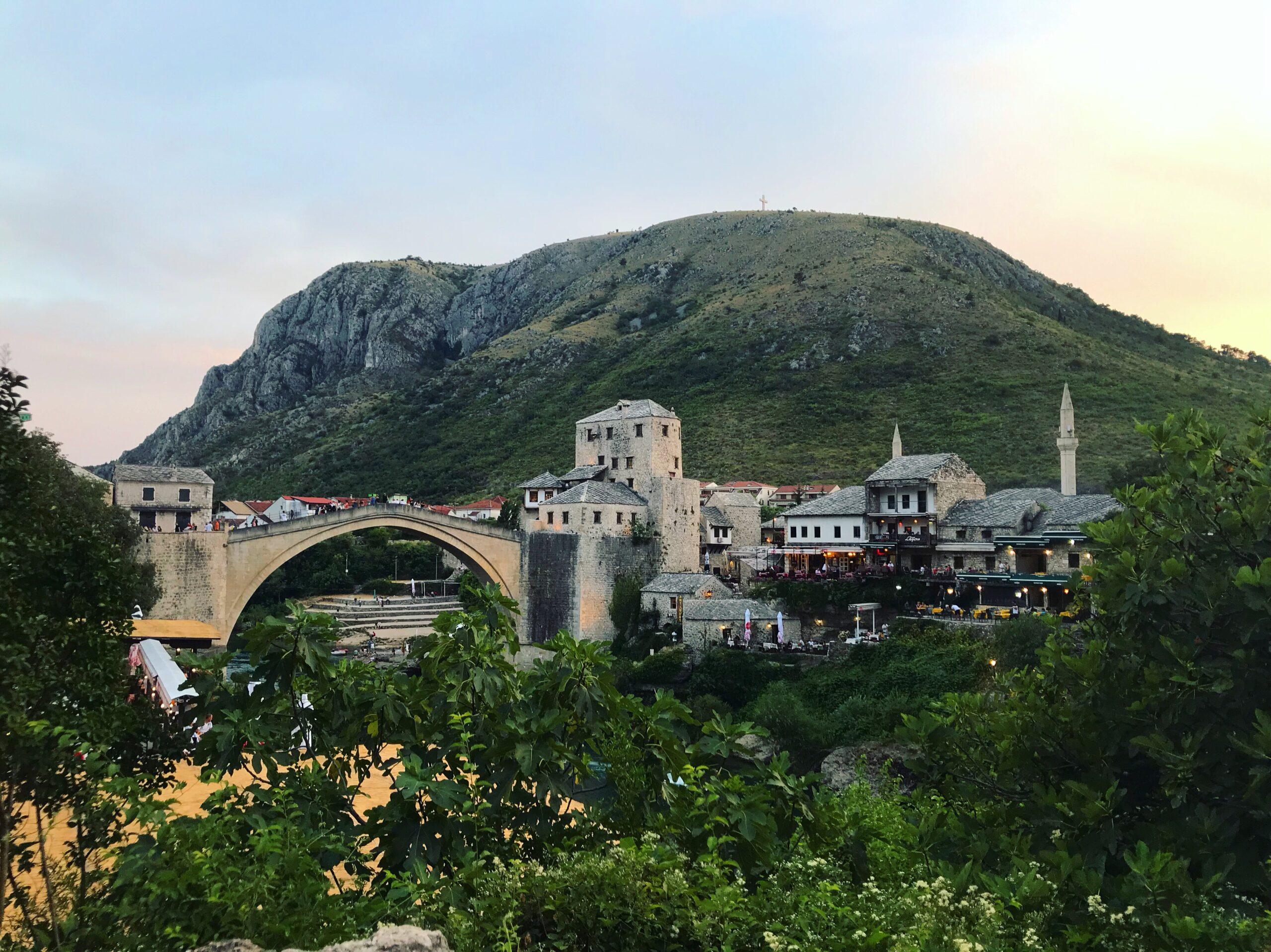
Mostar is unmissable and the photographs do not do it justice. The city’s centrepiece — Stari Most, the reconstructed 16th-century Ottoman bridge — spans the emerald-green Neretva River in a single elegant arc that looks, from the right angle, as though it might have grown there organically, as natural as the limestone cliffs that flank it. Park the bike in the old town and spend an afternoon here. Drink thick Bosnian coffee in the old bazaar, where copper craftsmen still work by hand in shops that have barely changed in four centuries. Watch the bridge divers — young men who hurl themselves off the parapet into the Neretva far below, a tradition that doubles as a local rite of passage — and let the layers of history settle around you. Mostar is a city that wears its complicated past openly, and that honesty is part of what makes it so affecting.
From Mostar, the route climbs into the mountains of central Bosnia on roads that become increasingly spectacular as the altitude rises. The road to Sarajevo through the highlands is outstanding — long sweeping corners, dense conifer forests, and the occasional small village that appears to have been entirely bypassed by the 21st century. Sarajevo itself rewards a long evening’s exploration. This is where Austro-Hungarian grandeur meets Ottoman bazaar culture meets the raw wounds of a recent war, all compressed into a city that has rebuilt itself with remarkable resilience and a café culture that would make Vienna envious. Spend the night here and walk the streets after dinner — it’s one of those cities that reveals itself best after dark.
Days 7–9: Montenegro — Kotor, Durmitor, and the Roads That Define the Country
Montenegro is, for most riders, the undisputed highlight of the route. The country is roughly the size of Wales but it packs in a genuinely staggering variety of terrain — Adriatic coastline, medieval walled towns, deep river canyons, dense forests, and mountain roads that rank among the most dramatic in Europe. It is a small country with an enormous sense of itself, and that self-confidence is infectious.
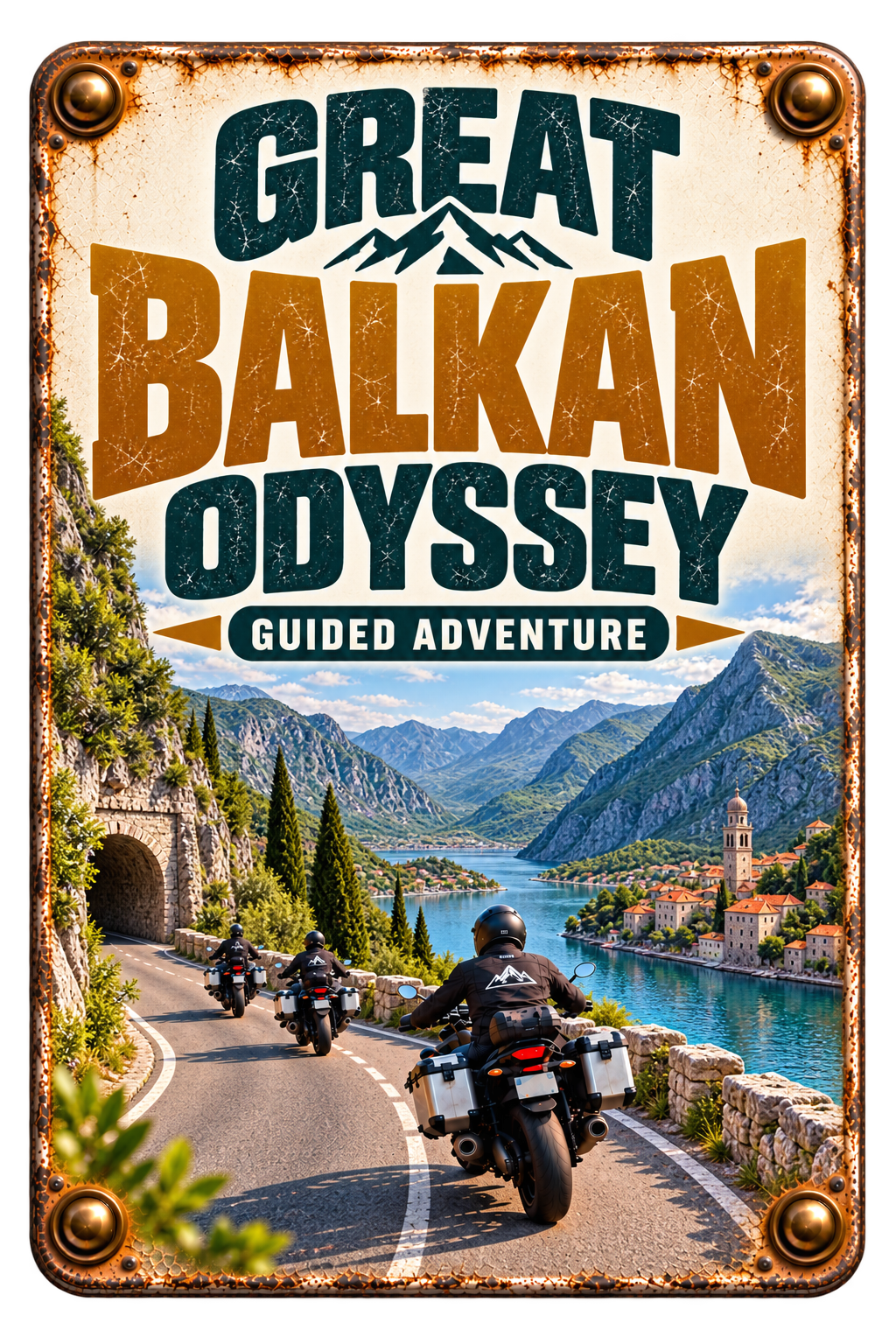
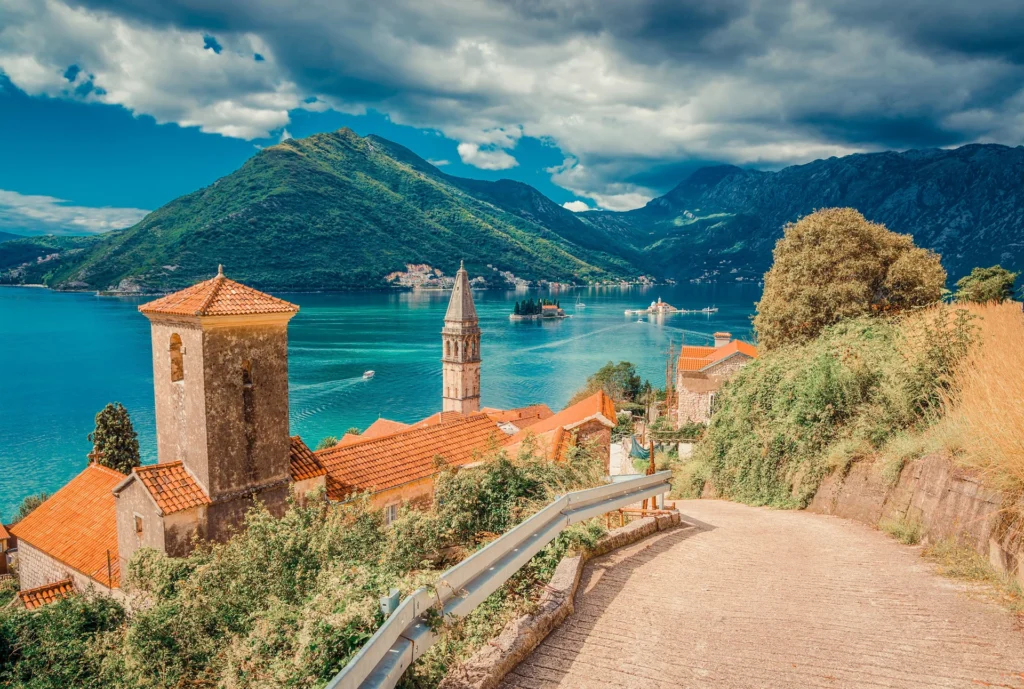
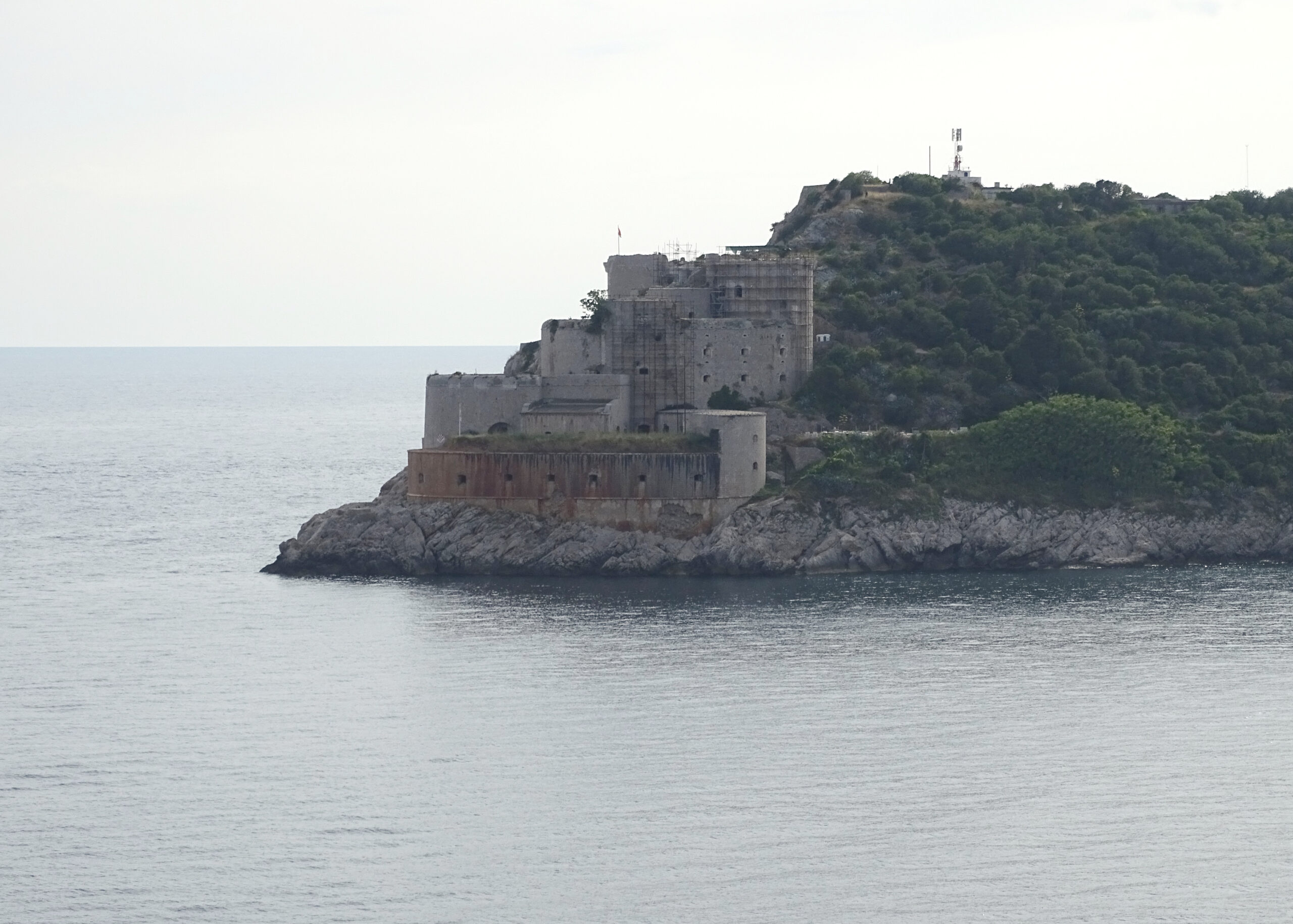
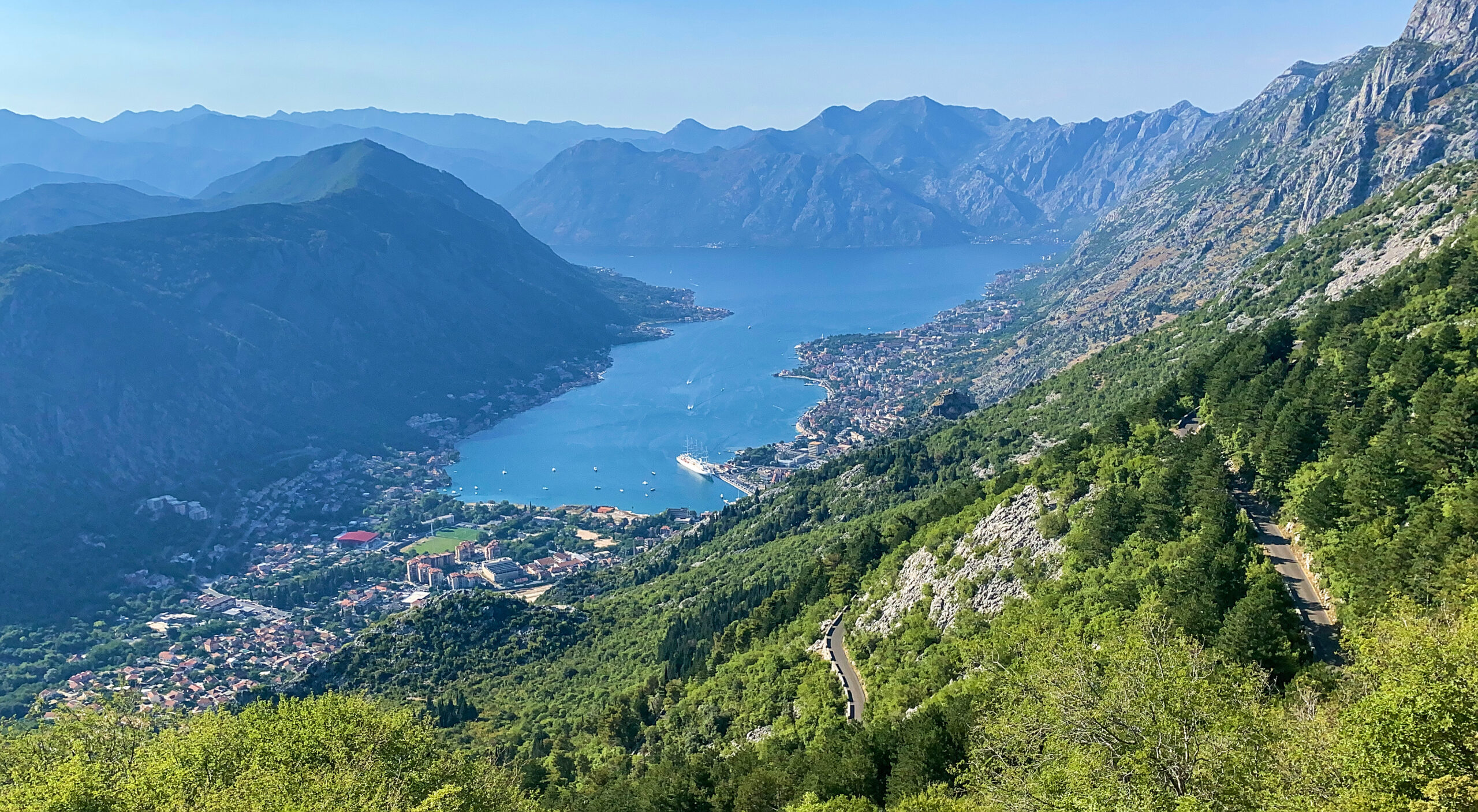
The Bay of Kotor arrives like a revelation. Descending from the mountains toward the coast, the road winds down through a series of hairpins and suddenly the bay opens below you — a deep, enclosed inlet that resembles a Norwegian fjord transplanted to the Mediterranean, ringed by mountains that drop almost vertically into water of an almost impossible blue-green. The coastal road that follows the bay’s edge is narrow, winding, and spectacular in every direction. Kotor itself — a UNESCO World Heritage walled city at the innermost point of the bay — is worth a full afternoon. The medieval walls climb steeply up the mountain behind the town and if you have the legs for it, the walk to the fortress at the top rewards you with a view over the bay that you will struggle to photograph adequately and will never entirely forget.
From Kotor, the route heads inland and upward toward Durmitor National Park — a complete change of character from the coastal glamour of Kotor, and all the better for it. The Tara River canyon runs through the heart of the park: at 1,300 metres deep and 82 kilometres long, it is the deepest canyon in Europe and the second deepest in the world after the Grand Canyon. The road that follows it is a motorcycling experience of the highest order — wild, remote, and largely empty, with the river churning green and white far below and the canyon walls rising sheer on both sides. Durmitor’s mountain roads feel genuinely high-alpine in character despite being further south than you’d expect. The air is cool and clean, the scenery changes constantly, and the sense of being in a landscape that is bigger and older and more indifferent to human presence than you are is — in the best possible way — humbling.
Days 10–11: Albania — Europe’s Best-Kept Secret
Albania is the wild card of the Balkans and the country that most riders either overlook entirely or have been warned off by a reputation that belongs to a different decade. The truth in 2026 is that Albania is changing faster than almost anywhere else in Europe. Infrastructure investment has transformed many of the main roads, the cities are buzzing with a youthful energy that feels genuinely optimistic, and the welcome from locals is among the warmest and most spontaneous you’ll encounter anywhere on the continent.
The northern Albanian Alps — known locally as the Bjeshkët e Namuna, or the Accursed Mountains — are simply staggering. The road through the Valbona Valley is increasingly well-maintained and passes through landscapes that feel genuinely untouched: dark pine forests, glacially carved valleys, limestone peaks that turn pink at sunset, and rivers so clear you can see every stone on the riverbed from the saddle. Theth, at the end of the valley, is a tiny traditional village that has become a magnet for travellers who want something completely off the beaten track. If you’re on an adventure bike, the unpaved sections in this area are entirely manageable and the reward is scenery that most of Western Europe simply cannot match.
Don’t miss Shkodër — the gateway city to northern Albania and a handsome place with a Venetian-era castle, a bustling bazaar, and excellent local food. Push on toward the Lake Ohrid region on the North Macedonian border as the day closes, following a lakeside road that mirrors the water as the light goes golden and the mountains throw their reflections across the surface.
Days 12–14: North Macedonia and the Road Home
North Macedonia is often the country that gets squeezed out of Balkans itineraries, which is a mistake. It is quiet, affordable, and genuinely beautiful in a way that hasn’t yet been commodified by mass tourism. Ohrid — a UNESCO-listed town on the shore of one of Europe’s oldest and deepest lakes — is the cultural heart: Byzantine churches perch above the water on rocky outcrops, a Roman amphitheatre overlooks the lake from the hillside, and the waterfront fills with locals in the evenings in a way that feels entirely unperformed. Lake Ohrid itself has been continuously inhabited since the Stone Age and the water has a clarity that makes the bottom visible at depths that seem impossible.
Skopje, the capital, is worth half a day for reasons that are hard to explain without seeming unkind. The city rebuilt its central district in neo-classical style after 2014, installing fountains, statues, and colonnaded facades on a scale that is simultaneously grandiose and slightly baffling — it is one of the more extraordinary urban environments in Europe and endlessly interesting to ride through and explore on foot.
From Skopje, the route turns north through Serbia toward the Croatian border and ultimately back to Ljubljana. The motorways are good, the fuel is cheap, and this final stretch is the place to make up time if you’ve spent it wisely elsewhere. The final evening — somewhere in Ljubljana with a glass of local wine and two weeks of roads settling in your memory — is when the journey reveals itself in retrospect as the thing it actually was: not a holiday, but an education. A reminder that the world is bigger and stranger and more beautiful than the familiar routes suggest, and that the best roads are always the ones that take some effort to find.
Practical Information
Best Time to Ride
May–June and September–October are the sweet spots for this route. The summer months of July and August bring heat that can be punishing at low altitude on the coast, tourist crowds that significantly affect the Dalmatian Highway and Dubrovnik, and afternoon thunderstorms in the mountains that can roll in quickly and with real force. Spring and early autumn offer cooler temperatures, roads that are fractionally quieter, and a landscape that is at its most photogenic — wildflowers in the mountain passes in spring, amber and rust in the forests come autumn. May in particular hits a near-perfect sweet spot: warm enough at sea level, cool enough in the mountains, and green everywhere.
Border Crossings
Slovenia and Croatia are EU Schengen members, so the first crossing is the one that counts for UK passport holders. From Croatia southward, you’ll be crossing between non-EU nations frequently — Montenegro, Bosnia and Herzegovina, Albania, and North Macedonia all require their own entry procedures. You’ll need your passport, your V5C logbook, and crucially, a Green Card from your motorcycle insurer confirming coverage for each country. Check this carefully before departure — some policies exclude Albania, and discovering this at the border is not an experience you want. Allow extra time for border crossings throughout the route; some are quick and efficient, others are not, and the difference is rarely predictable in advance.
Fuel and Money
Fuel availability is reliable in Slovenia and Croatia. As you move south and east, plan your stops more carefully — particularly in the mountain regions of Montenegro, Bosnia, and northern Albania, where stations can be genuinely sparse and the next one may be 80 kilometres of mountain road away. Fill up whenever the opportunity presents itself.
The currency situation across the route reflects the region’s complexity: Slovenia uses the Euro, Croatia joined the Eurozone in 2023, Montenegro uses the Euro despite not being an EU member, Bosnia uses the Convertible Mark (pegged to the Euro), North Macedonia uses the Macedonian Denar, and Albania uses the Lek. A combination of card and cash covers most situations; carry a reasonable float of Euros throughout as they are accepted informally in many places even where not the official currency, and are invaluable as backup when ATMs are unavailable.
What Bike to Bring
An adventure tourer with moderate ground clearance is the ideal machine for this route — something like a BMW R 1250 GS, Triumph Tiger 900, Honda Africa Twin, or KTM 890 Adventure. You don’t need a dedicated off-road motorcycle, but you’ll appreciate the confidence that comes from decent suspension travel and reasonable clearance if you choose to explore the unpaved sections in Albania or the higher gravel passes. Full-sized adventure tourers will feel slightly unwieldy on the narrowest mountain roads, but nothing that experience won’t manage. Sports tourers — a Ducati Multistrada, Yamaha Tracer, or similar — will handle the vast majority of the route with complete competence; just be prepared to be selective about which tracks you follow into Albania.
Whatever you ride, make sure it’s in good mechanical shape before departure. Getting parts shipped to rural Montenegro or northern Albania is not a quick process, and local dealers capable of servicing anything beyond a basic commuter are thin on the ground in the more remote areas. A pre-trip service, fresh tyres, and a basic toolkit under the seat are non-negotiable.
Ride It With Wild Roads
The Balkans route is one of those journeys that sounds ambitious on paper and feels genuinely transformative in reality. It asks more of you than a week in the French Alps or a blast down to Portugal — different paperwork, different currencies, roads that require your full attention — but it gives back in proportion to what it demands. The landscapes are extraordinary, the history is everywhere, the food is better than you expect, and the sense of having ridden somewhere that hasn’t been fully discovered yet is a feeling that’s increasingly hard to find in Europe.
At Wild Roads, we’re planning our first premium guided Balkans motorcycle tour for 2027. Small groups — never more than eight riders — experienced guides who know the roads, the border crossings, the hidden stops, and the places where the coffee is worth stopping for. We handle the logistics so you can focus entirely on the riding. The route will be finalised over the coming months and places will be limited. Browse our full 2027 motorcycle tour calendar to see all our planned routes and dates.
Fill in the form below and we’ll send you the full 2027 tour pack, or download the 2027 tour pack directly — routes, dates, pricing, what to bring, and everything else you need to make it happen.
Ride Free. Ride Wild. 🤙
Joshua James
Wild Roads Motorcycle Tours