Day 7: Argomaniz to the Pyrenees — Picos & Pyrenees May 2026
📖 Day 7 · 27th May 2026
Argomaniz to the Pyrenees
Final farewells, first Pyrenean views, the Larrau Pass at 1,585m — and excellent steaks in France.
Leaving Argomaniz
There’s a particular kind of morning that only happens on a motorcycle tour — the one where you know some of the group won’t be there at dinner. Four riders were heading home the next day, catching the ferry from Santander back to the UK. The Parador breakfast was the last one together for all of them, and there was a quality to the conversation that morning that everyone felt but nobody quite put into words.
The bikes loaded, we pulled out of Argomaniz and headed south into the Basque Country — a landscape that shifts almost imperceptibly from the Castilian plains into something wilder, greener, and more vertical. The road quality is superb through here, the traffic almost non-existent, and the kind of corners that appear just often enough to keep you properly engaged.
The Last Coffee Together
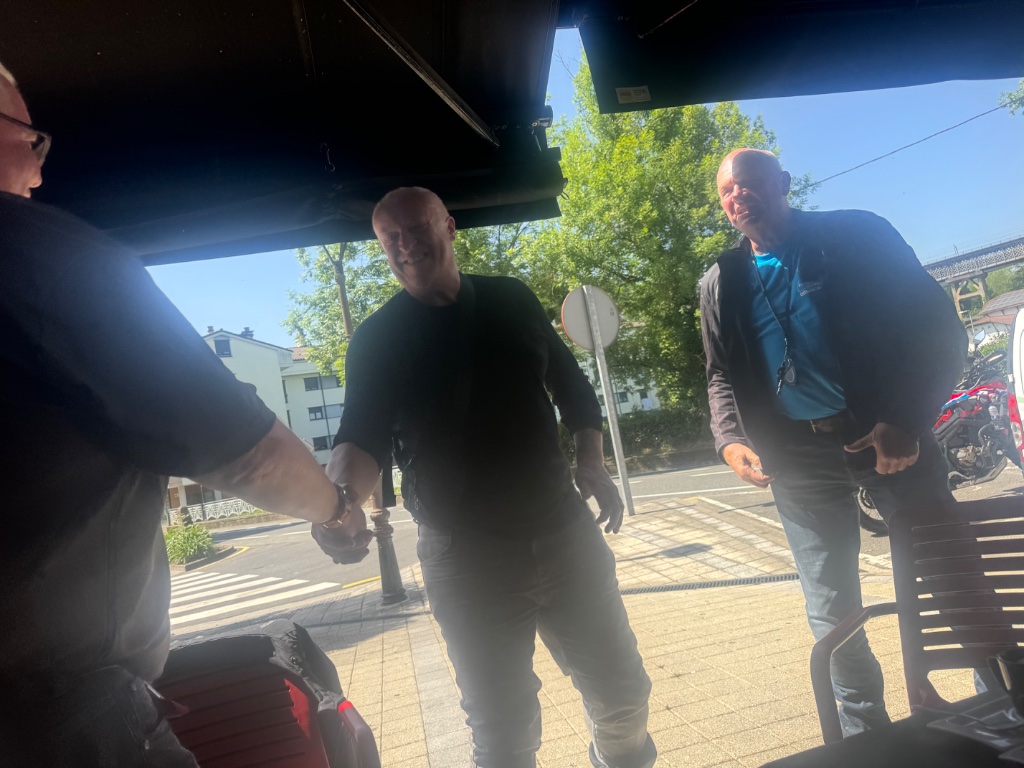
The last coffee stop together. Four riders heading home from here — the rest of us heading deeper into the mountains.
We pulled into a small Basque village for the morning coffee stop, and that’s where it happened — the moment the tour quietly split in two. Four riders peeled off to make their way back toward Santander and the ferry home. Handshakes, a few photos, the usual promises to do it again. Then they were gone, and the remaining six of us were left standing in the sunshine with a very different kind of road ahead.
There’s something that happens to a group dynamic when it gets smaller. The remaining riders pulled a little closer together — the conversation got more relaxed, the pace found a different rhythm. Six riders, one guide, and the Pyrenees waiting on the horizon. That’s a very good situation to be in.
Deeper Into the Basque Mountains
The route south and east from the Basque lowlands takes you into terrain that most touring riders never find. The valleys narrow, the road starts climbing properly, and the forest closes in on either side. Villages become smaller and further apart. The signs switch from Spanish to Basque — Euskara — a language with no known relatives anywhere in the world, spoken here for thousands of years before anyone else arrived.
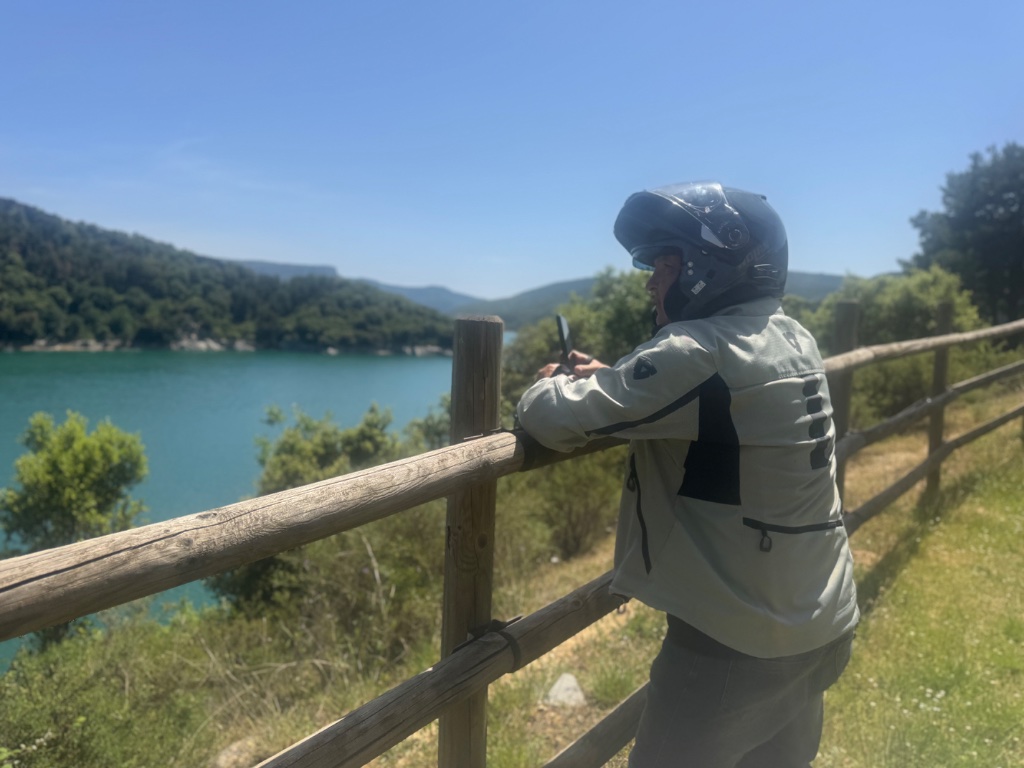
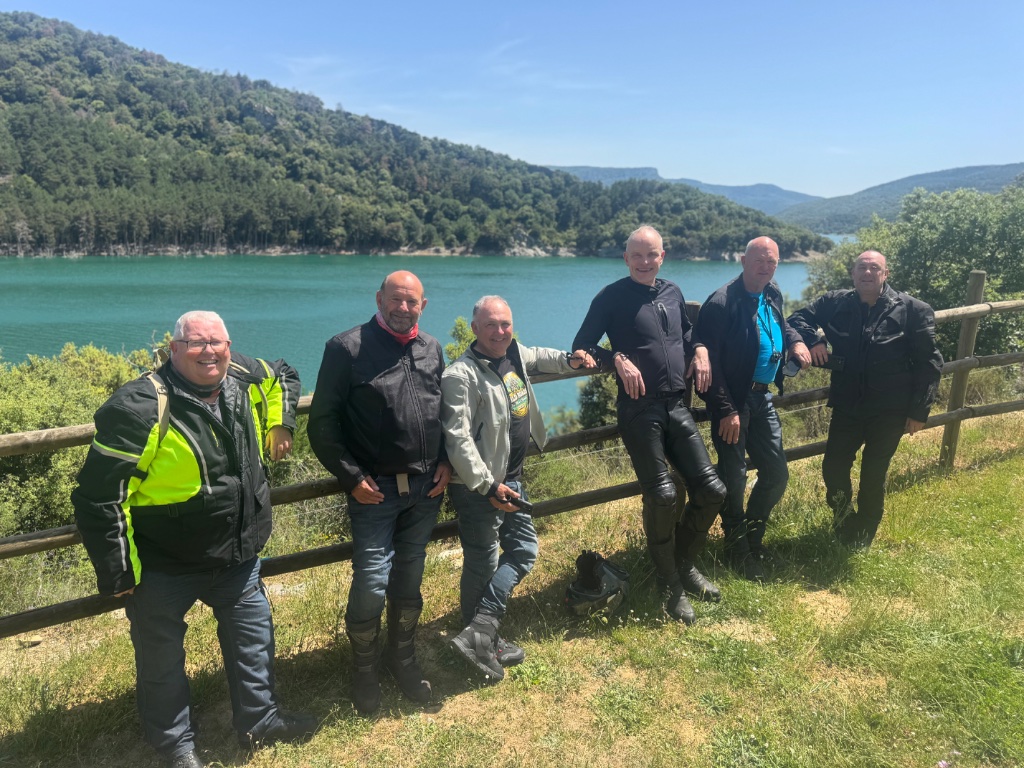
That turquoise. The group found a lake viewpoint that nobody wanted to leave in a hurry.
Then a lake appeared — completely unexpectedly, in the way the best things always do on a motorcycle tour. Turquoise water, deep green forest on the surrounding hills, the colour so vivid it looked artificially saturated. The group pulled over at the wooden fence viewpoint and the phones came out immediately. You don’t argue with a view like that. You just stop and look at it for a while.
First Sight of the Pyrenees
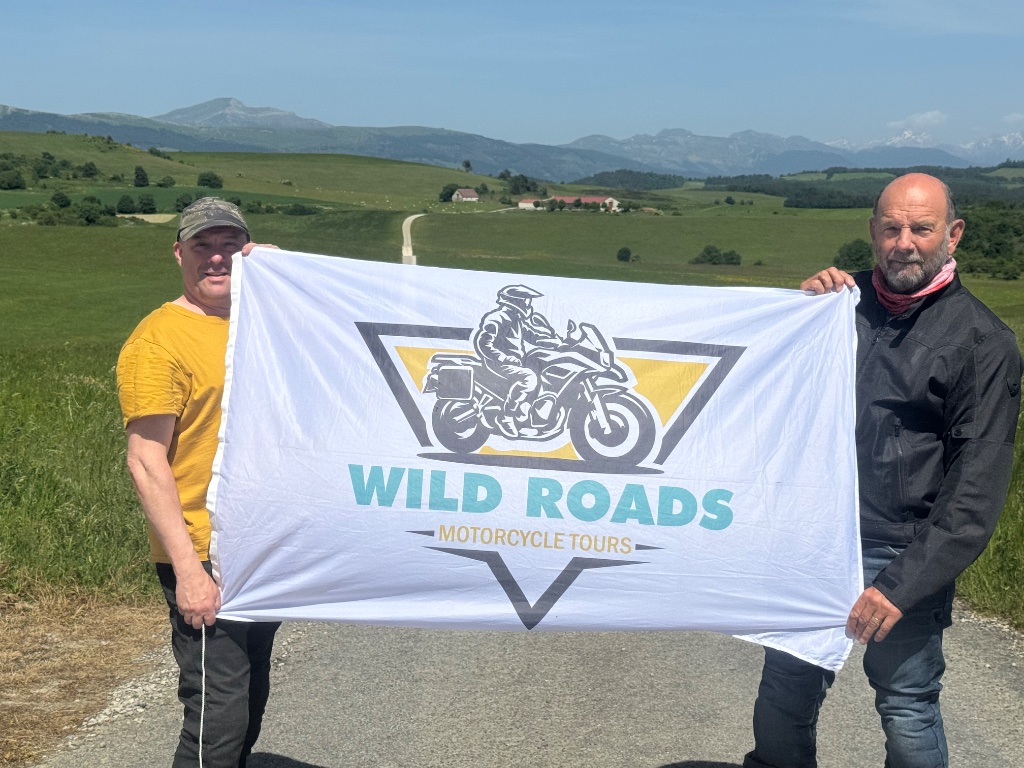
The flag comes out. The Pyrenees arrive on the horizon. This is the moment.
And then the mountains appeared. The Pyrenees don’t announce themselves subtly — they rise from the horizon like something that was always there but has been hidden until exactly this moment. Snow still on the higher peaks, the ridgeline dramatic and clear against the blue sky, the scale of the range becoming apparent the closer you get.
The group pulled over on a quiet mountain road somewhere in the high Navarrese countryside — rolling green hills, a lone farmhouse visible on a distant track, the Pyrenees filling the sky behind. Someone produced the Wild Roads flag. It was that kind of moment.
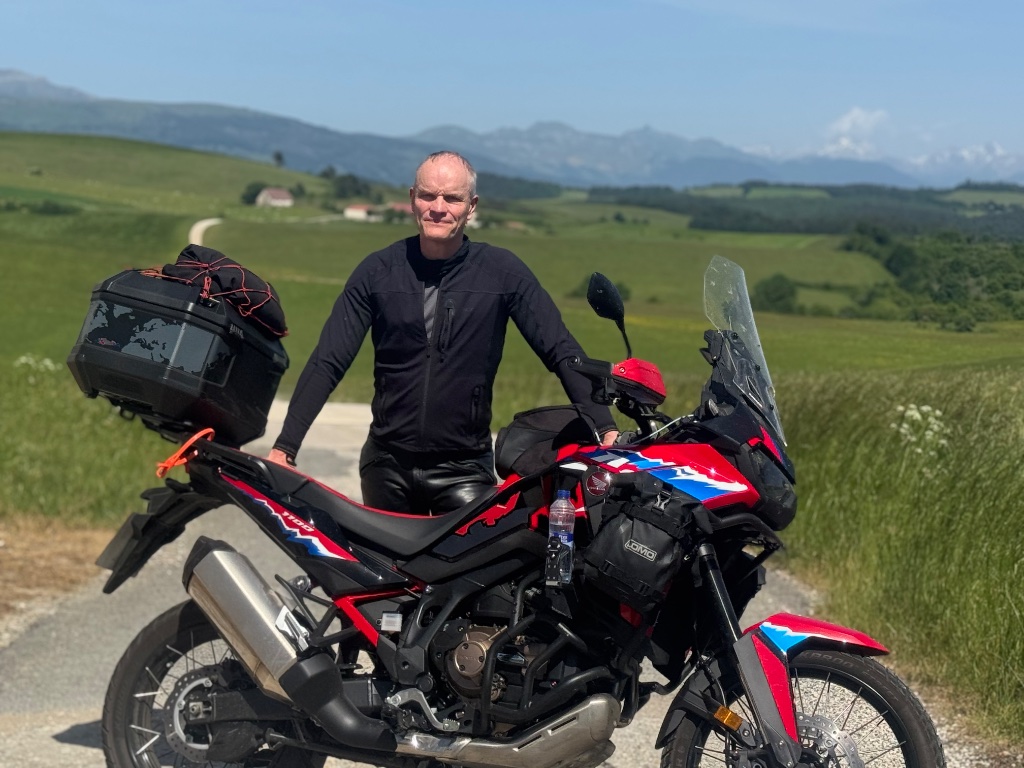
The Honda Africa Twin in its element. Snow-capped Pyrenees, green hills, not another vehicle in sight.
The Pyrenees — A Rider’s Mountain Range
The Pyrenees form the natural border between Spain and France, stretching 491km from the Atlantic to the Mediterranean. The range has over 200 summits above 3,000m, but it’s the mid-altitude passes — between 1,000m and 2,000m — that make it one of the great motorcycle destinations in Europe. The roads are technical, the scenery extraordinary, and the traffic almost non-existent outside of summer weekends.
The Larrau Pass — 1,585m
The Port de Larrau — also known locally as the Porte de l’Horreur — sits at 1,585 metres on the border between Navarre and the French Basque province of Soule. The name “Porte de l’Horreur” gives you a reasonable indication of what it was like to cross this pass before the road was surfaced. Today it’s one of the finest mountain passes in the entire Pyrenean range — narrow, technical, with gradients that keep you focused and a summit view that makes every metre of climbing worthwhile.
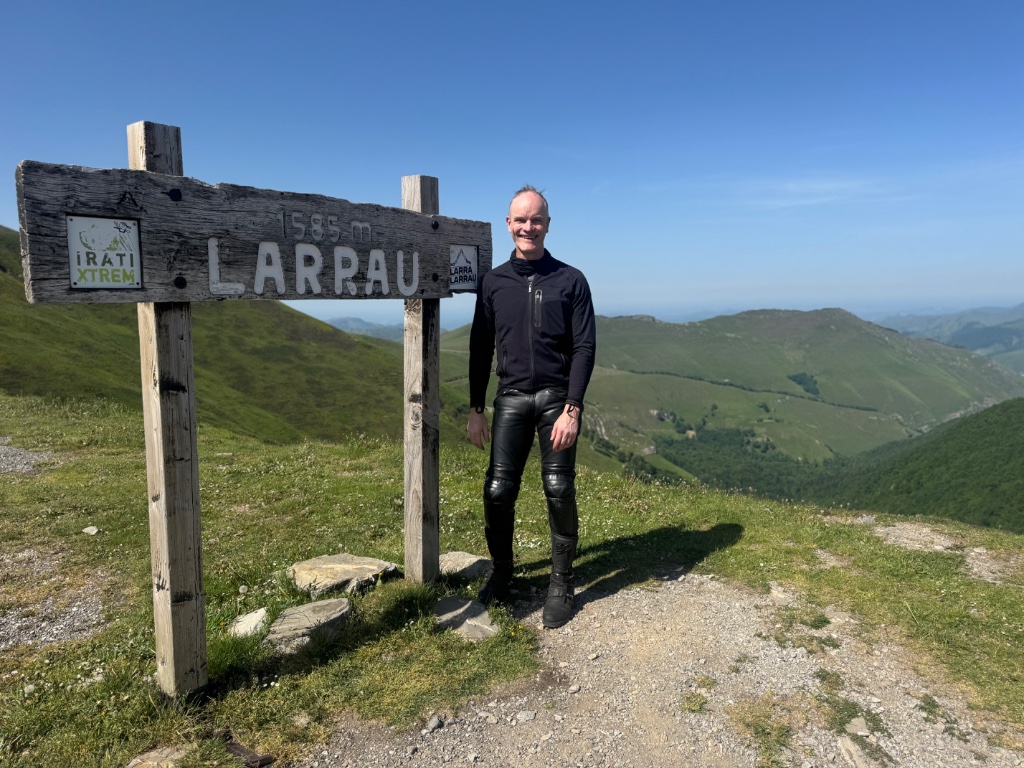
1,585 metres. The Larrau summit sign. That view behind isn’t a filter — it just looks like that.
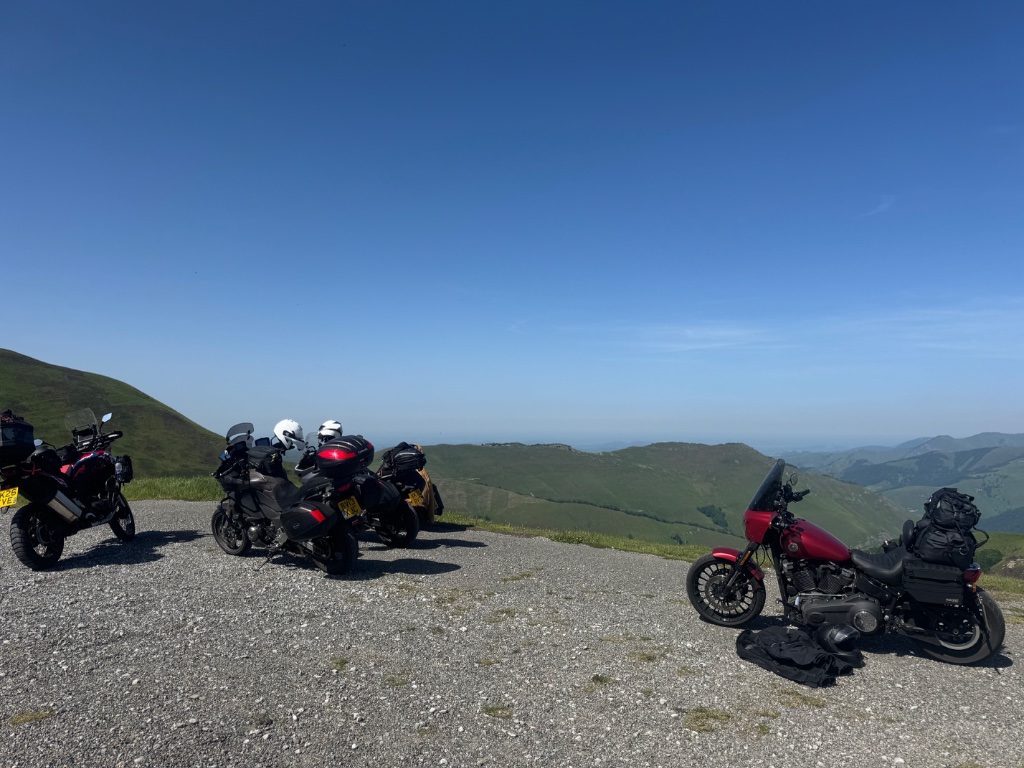
The fleet at the top. BMW, Honda Africa Twin, Harley-Davidson — all of them earned their way up here.
The approach road is everything a motorcyclist could want — tight, smooth, relentlessly twisting, with the mountain rising sharply on one side and the valley dropping away on the other. The kind of road where you arrive at the top slightly amazed that you got there, and immediately want to know what the descent looks like.
The Descent
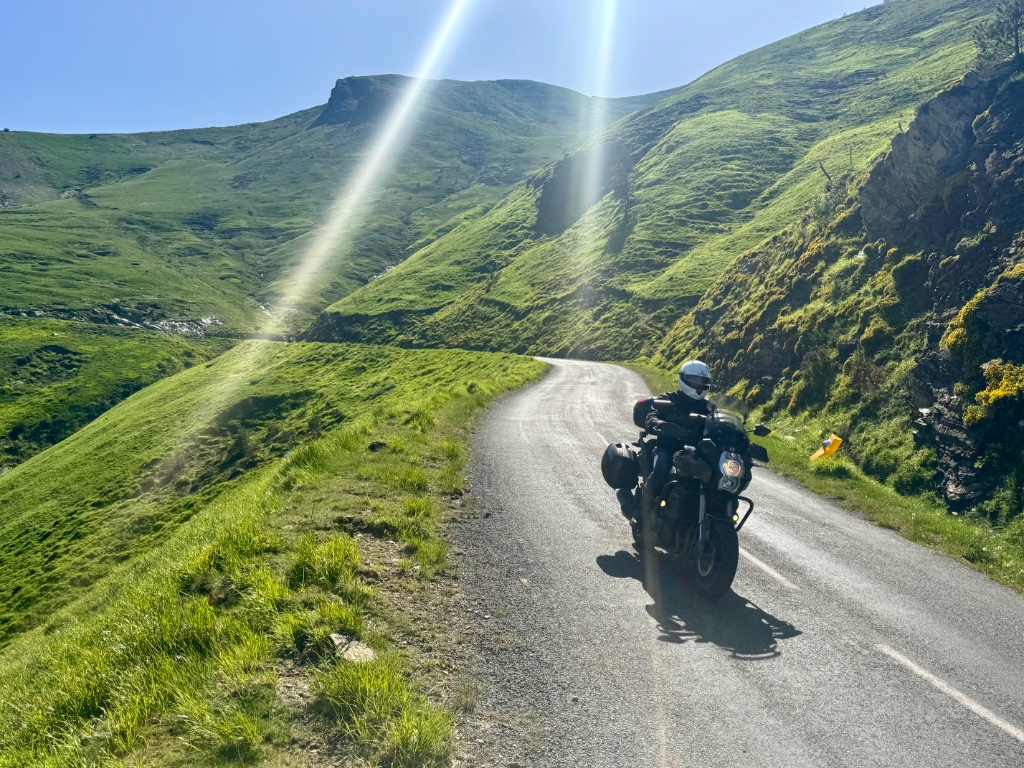
The road to Larrau. Vivid green, narrow tarmac, mountain above. This is what you came for.
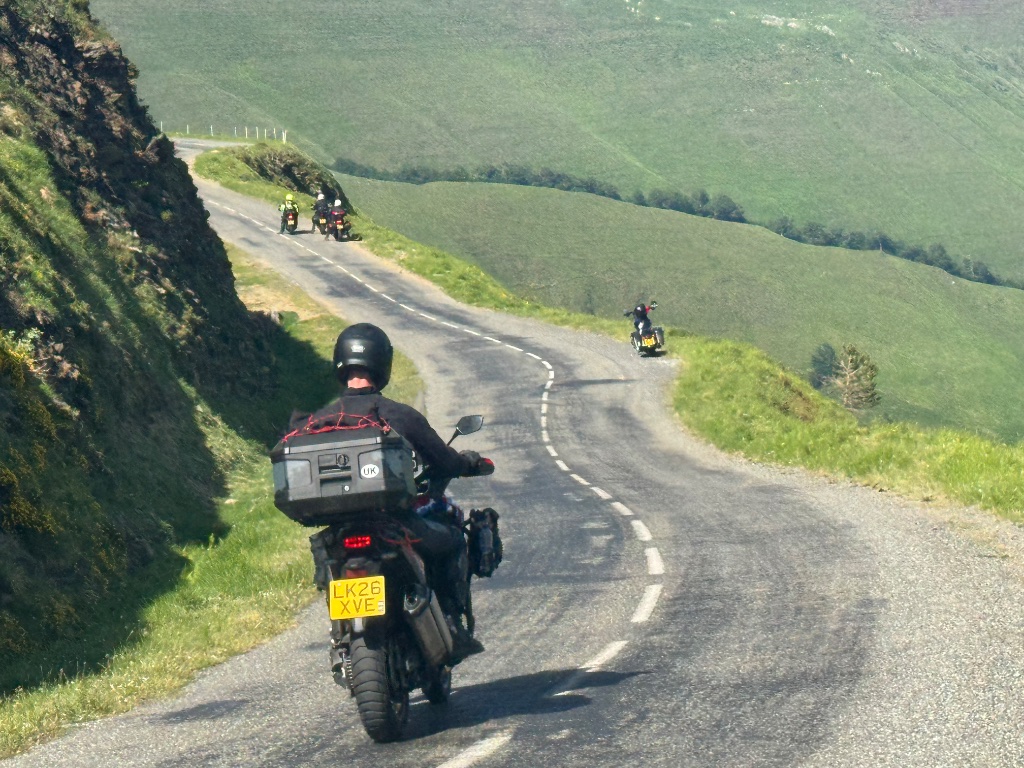
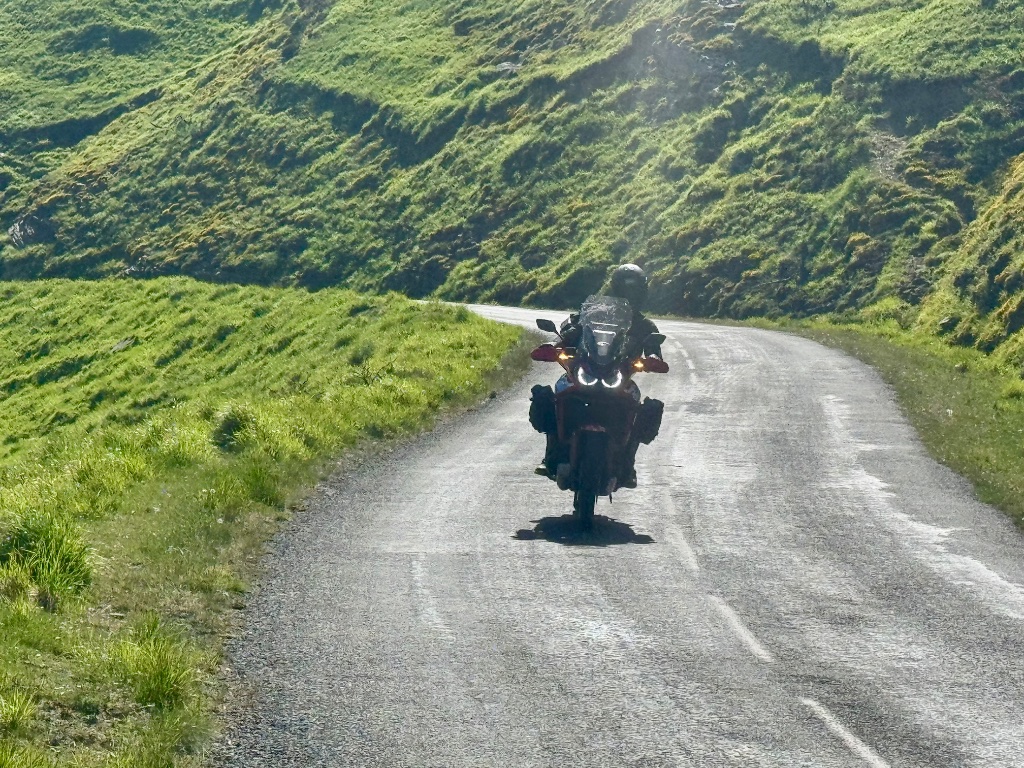
The descent from Larrau into France. Narrow, green, exhilarating — and nobody else on the road.

That’s what it feels like at the top. Green ridgelines as far as you can see.
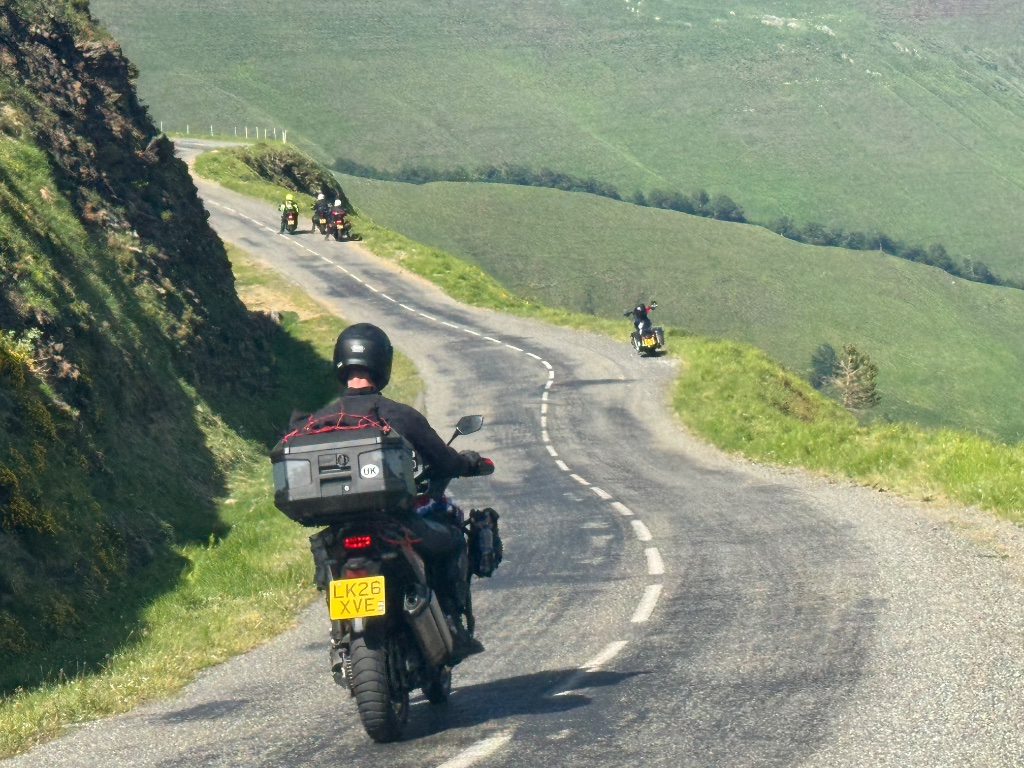
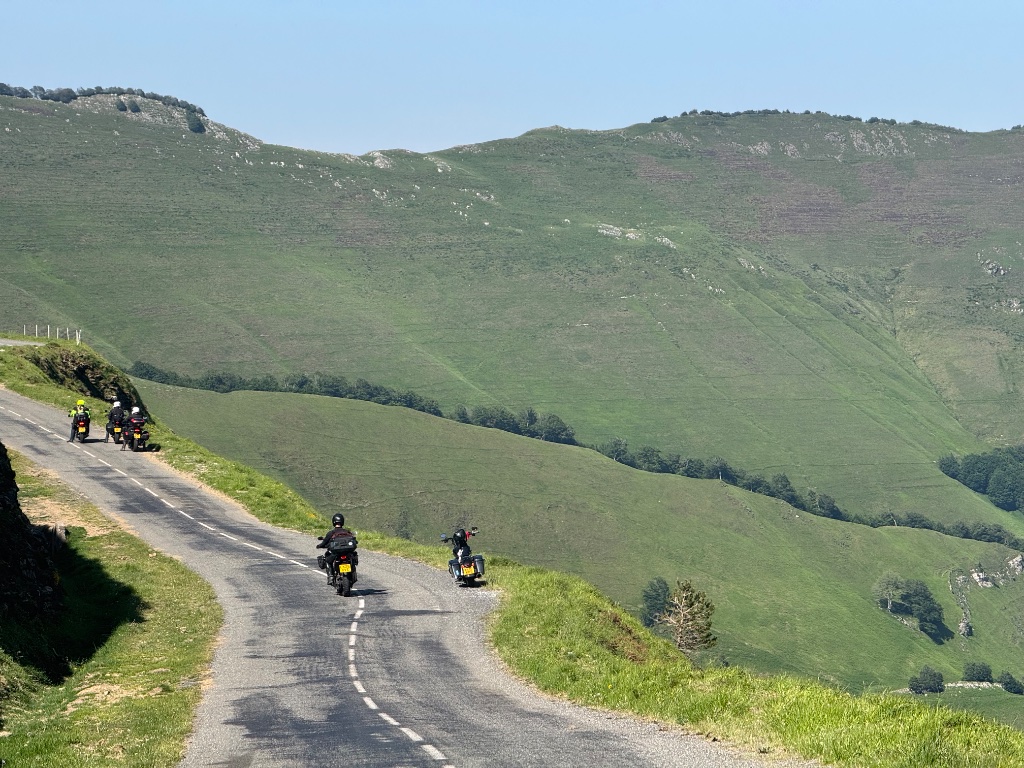
The group threading down through the Pyrenean valleys. This is what the Larrau descent looks like.
The French side of the Larrau is, if anything, even more spectacular than the Spanish approach. The road narrows to barely one vehicle wide in places, the hillsides brilliantly green, the tarmac following the natural line of the mountain with a logic that only makes sense on two wheels. The group threaded down into the valley in single file, each rider finding their own line, the Pyrenean light doing extraordinary things to the colour of the grass and rock above.
Arrival in France — Two Nights, Excellent Steaks
We arrived in the small French village of Montory in the Soule valley — a place that feels genuinely remote despite being less than two hours from Biarritz. Stone buildings, a church, a handful of houses, and a hotel — the Logis Hôtel l’Auberge de l’Etable — with a swimming pool and a restaurant that knows exactly what to do with a steak.
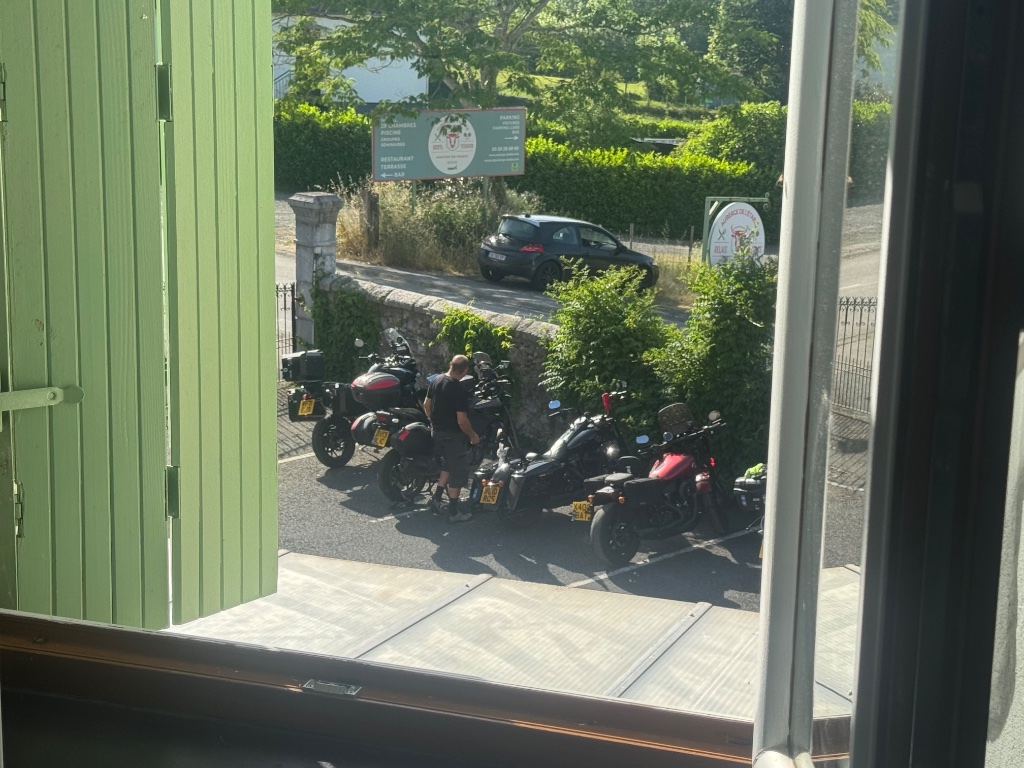
View from the bedroom window. The bikes don’t go far. Neither do the riders.
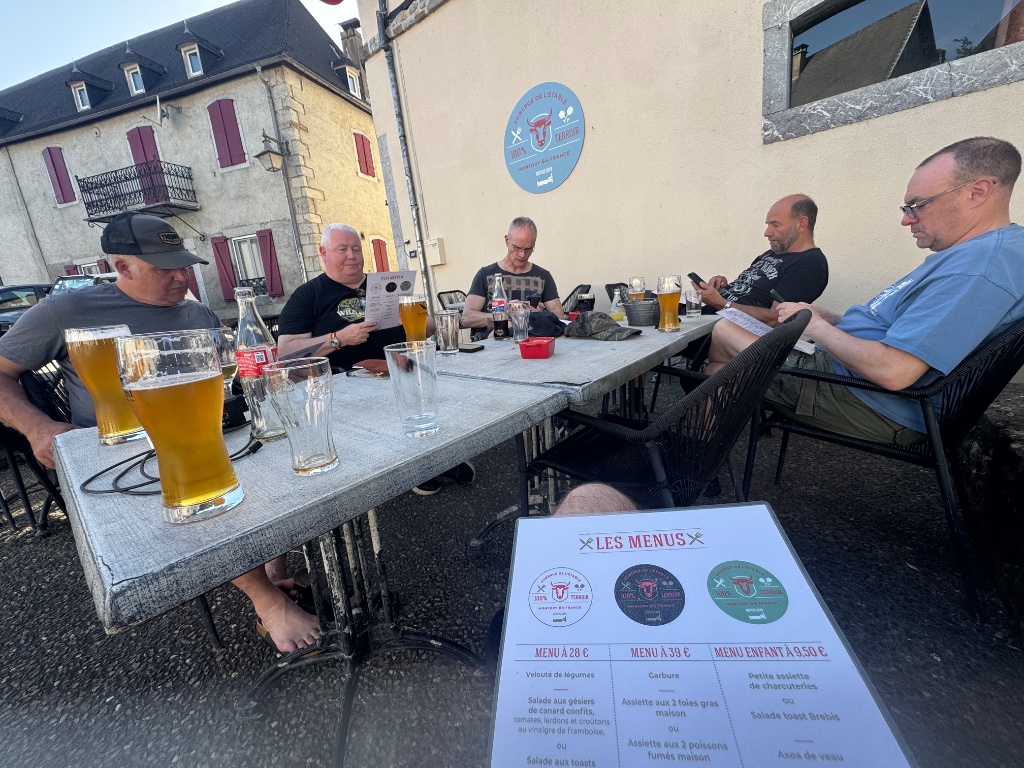
First order of business: cold beer and the menu. The Logis Hôtel l’Auberge de l’Etable does a proper set menu — three courses of serious French Basque cooking.
After a week of Spanish cooking — excellent in its own right — there’s something particularly satisfying about sitting down to a proper French dinner. The Basque Country straddles both sides of the Pyrenees, and the food on the French side reflects that mix — foie gras, Bayonne ham, local charcuterie boards, and beef that’s been raised on mountain pasture and actually tastes like it.
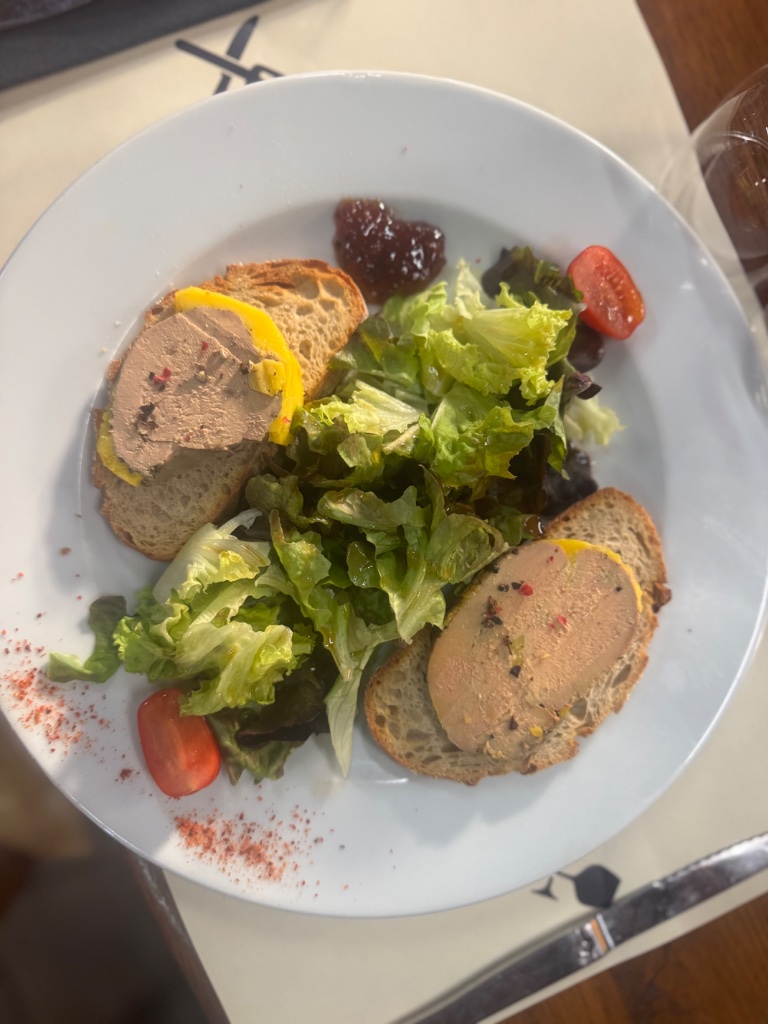
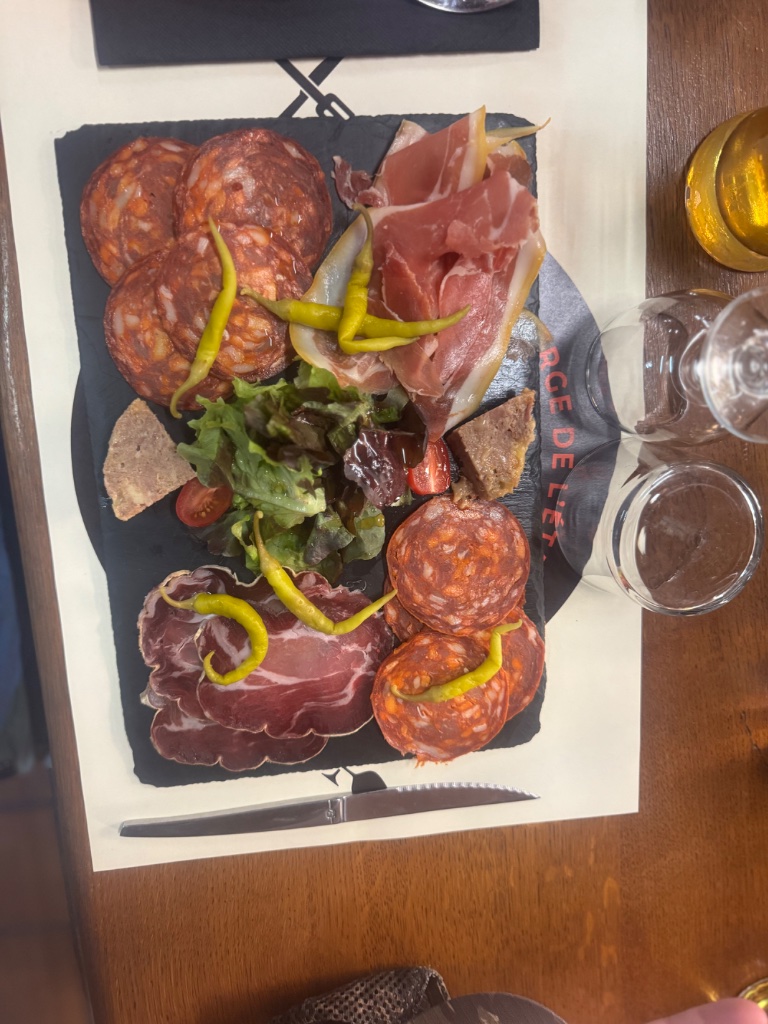
Foie gras and a charcuterie slate to start. This is not a bad way to end a riding day.
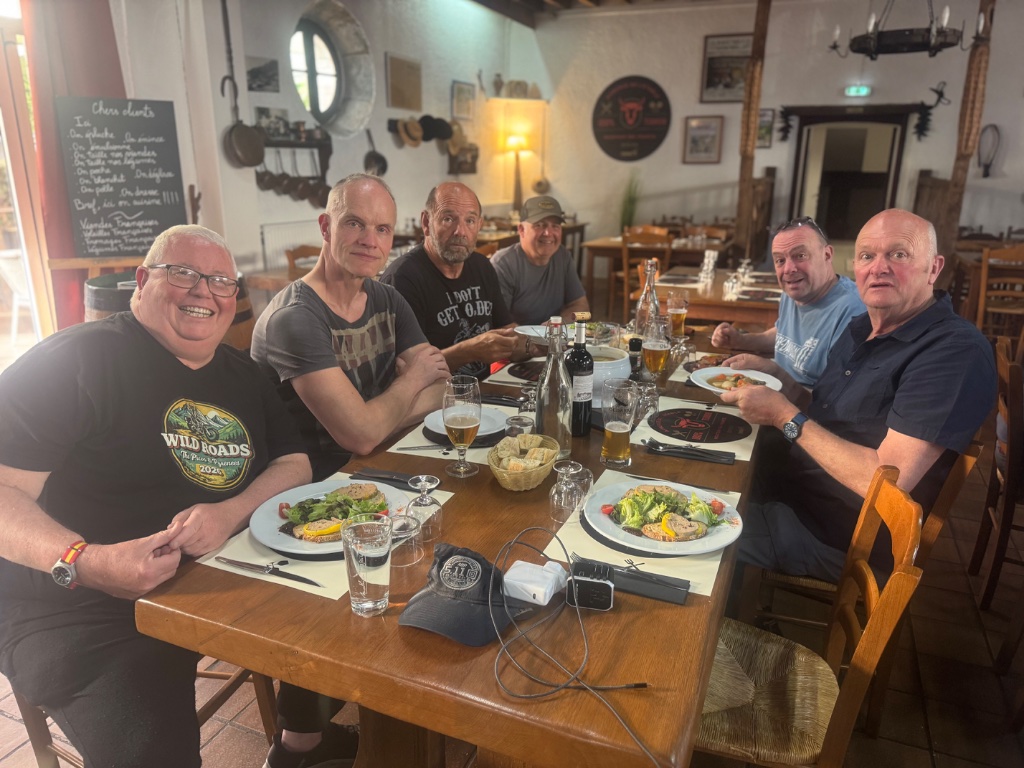
Six riders around the table. Wild Roads T-shirts, big smiles, wine already open. Job done.
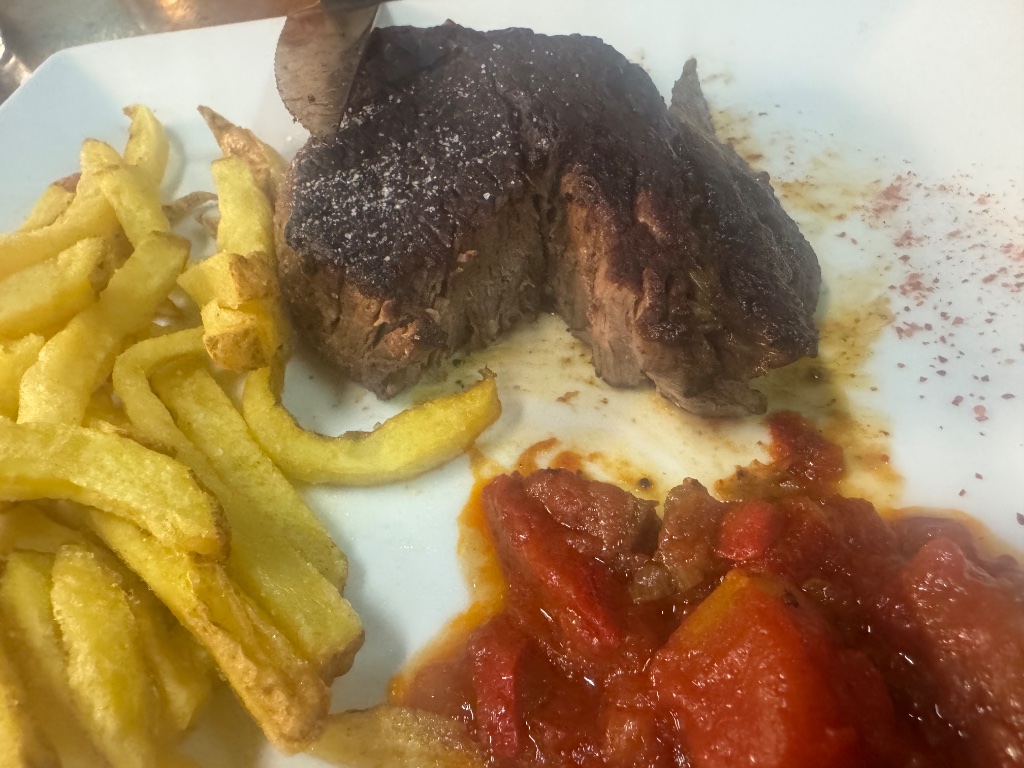
The steak. Proper mountain beef, properly cooked, with a Basque tomato sauce and frites. The steaks were good. That’s an understatement.
The pool was very welcome after a day that had taken the group from a Basque Parador over a 1,585-metre mountain pass and into France. Everyone earned it — and everyone slept well.
The plan was to stay two nights. The next day would be a half-day loop into the surrounding passes — no bags, no schedule, just the bikes and the mountains. The Pyrenees had introduced themselves. Tomorrow was about getting properly acquainted.
The Picos & Pyrenees tour takes you from Plymouth through northern Spain, over the Larrau Pass and into France — 15 days of riding on some of Europe’s finest roads.
View the Picos & Pyrenees Tour →